In the demanding world of contemporary serious drifting, victory is not merely purely a function of raw engine power or behind-the-wheel aggression. Conversely, it is now a complex science that requires a painstaking marriage of picking a inherently capable vehicle platform, outfitting it with the most precise drift-spec components, and, most essentially, grasping its live characteristics on the course through cutting-edge drift telemetry software. This definitive manual functions as your master plan starting from the initial concept of a competition vehicle all the way to the final data-informed tweaks that turn a capable car into a consistent winner. We will thoroughly explore the precise engineering of chassis dynamics adjustment, showing how a state-of-the-art drift tuning app like precise measurement hardware removes assumptions and provides unparalleled clarity into your car's true dynamics.
The cornerstone of any great competitive sliding vehicle is, undoubtedly, the chassis itself. Several cars have achieved renowned status within the international sliding community due to their built-in weight distribution, robust design, and the enormous ecosystem of aftermarket support available. Selecting the right starting point is the initial and most significant decision a builder will make. To illustrate, the BMW's E36 3 Series is commonly accepted as one of the finest all-around drift platforms of the modern era. Its near-perfect balanced front-to-rear weight, alongside a rear-wheel-drive configuration and extremely reliable straight-six motors, establishes a platform that is both easy to handle for newcomers and extremely competitive in the control of a pro pilot. The successor of this lineage, the BMW E46 platform, refines these attributes with a more sophisticated chassis, increased wheel track for improved stability, and even more steering angle straight from the OEM. Another dominant contender in the pro arena is the C6 generation Corvette.
This V8-powered sports car brings a particular set of strengths to the drifting sport, featuring a light alloy structure, a transaxle-style transaxle that aids in an excellent front-to-rear mass ratio, and the immense low-end power of a powerful LS-series V8 engine. This blend transforms it into an absolute force on track, designed of initiating and maintaining extended slides with seemingly effortless deployment of acceleration. For drivers desiring remarkable value, the 350Z model Nissan excels as a prime example. It comes from the factory with a stiff platform, a competent OEM LSD, and the smooth VQ35DE powerplant that delivers plenty of performance for practicing and advancing in the activity. Its newer version, the 370Z model, offers more refinements in structural rigidity, handling precision, and peak powerplant output, cementing its position as a favorite selection among competitive drivers. Other historic vehicles that merit attention encompass the agile Wankel-engined Mazda FC, the ever-present Nissan S13 240SX, the American Ford Mustang SN95, the modern BMW E90, and the tiny yet incredibly playful and teachable Mazda Miata. Every single one of these cars offers a unique set of characteristics, challenges, and capabilities, but they all have in common the core ingredients essential to be transformed into a capable drift car.
However, picking the optimal chassis is only the beginning. To release the full capability of every of these vehicles, major changes to the steering and damping and springing systems are absolutely mandatory. This is where the world of specialist aftermarket components comes into vital importance. The most most transformative upgrade for a serious competition vehicle is the fitting of a high-performance angle modification kit. These engineered kits, such as those developed by specialist companies like specialist manufacturers, are engineered to dramatically expand the vehicle's available steering angle. A factory street car is extremely constrained in how far its front wheels can rotate, a design compromise for daily driving. In sliding, however, aggressive countersteering is constantly needed to manage and sustain a slide. An steering kit replaces the OEM hubs, tie rods, and sometimes suspension arms with pieces that enable the front tires to attain angles in excess of 70 or even 80 degs, as opposed to a normal factory setting of around 40 to 50 degrees.
This immensely expanded capability offers the operator with exponentially more command during a slide, enabling it to be considerably more straightforward to begin a slide, sustain it through a long turn, and switch seamlessly from one angle to the opposite. The improvement in drivability is nothing short of revolutionary. Paired with a properly selected angle kit is the equally critical upgrade to the vehicle's suspension. Off-the-shelf or even high-end sport coilovers are generally not intended for the particular and extreme needs of competitive oversteer. A dedicated pair of adjustable dampers is of utmost importance. These engineered suspension components feature custom piston tuning and spring strength that are designed for the rapid load shifting that is characteristic of drifting. When a operator begins a slide, the vehicle's mass is shifted rapidly to the outer of the corner. Optimal performance dampers manage this shift in a controllable way, allowing the vehicle to stabilize rapidly and giving the operator precise feel through the steering wheel and seat. They also provide accurate tuning of ride height, damping rate, and cross-weight, which are all key parts of optimizing the car's handling to a given circuit or driving approach. In combination, a high-quality drift angle kit and a expertly selected set of performance adjustable dampers form the core physical foundation upon which all subsequent optimization is constructed.
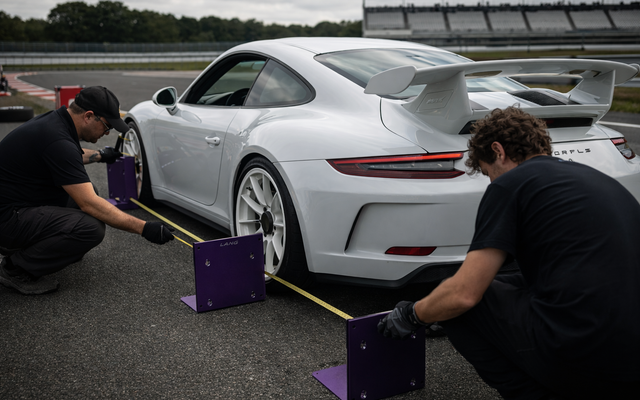
Once the core parts is in place, the subsequent critical step in the project is the meticulous setting of the car's alignment. This is the world of vehicle alignment optimization, a process that can feel intimidating to the uninitiated but is, in fact, the key to converting a collection of capable parts into a harmonious and predictable machine. The most discussed parameter of suspension geometry for sliding is definitely camber angle. Wheel camber is the tilt of the rim relative to the upright axis when observed from the forward of the vehicle. If the top edge of the wheel is angled inward, this is known as negative camber. For oversteer driving, negative camber on the front axle tires is generally used and is considered essential. The purpose is fundamentally tied to tire contact.
When a chassis is cornering at limit angles, the chassis tilts to the outer of the corner. This lean causes the outside steering tire to reduce its best grip area with the tarmac. By introducing an inward tilt, the wheel is pre-leaned to compensate for this roll. As the car rolls into the turn, the outside front tire gains a better contact patch against the road surface, increasing its traction at the critical moment when it is needed most for steering authority. Typically, front angles for a serious drift machine fall between approximately -3 degrees to as high as -5 degrees or even beyond, contingent on the specifics of the chassis configuration, rubber selection, and pilot style. The rear axle tires also use inward tilt, but the angles are typically more modest and more nuanced than the front. Excessive negative camber at the rear can make the car overly prone to oversteer and difficult to control on acceleration use, as it diminishes the effective contact patch of the driven tires during linear power delivery. Thus, rear adjustments are commonly in the ballpark of -1 degree to -3 degrees, striking a precise compromise between offering enough lateral bite to help in entering and maintaining the slide while still keeping good traction for exiting the turn. Camber is merely one part of the larger tuning equation, which additionally includes toe setting, caster, and bump steer modification.
Toe is the direction of the wheels as seen from above. Positive toe means the front edges of the tires are closer together than the trailing edges, while toe-out drift tuning app means the converse. For sliding, a modest amount of front negative toe is frequently used to quicken the initial directional response, making the car feel more responsive and ready to initiate a slide. Rear axle toe setting is generally set to neutral or a very slight amount of positive toe to promote predictability under acceleration. caster angle is the forward or aft tilt of the suspension pivot when looked at from the side of the car. Positive positive caster enhances steering feel and stability stability, and it furthermore increases inward lean effect during turning, which is very useful. Adjusting these settings is a detailed interplay where a adjustment to a single setting can and often will affect the other settings. The conventional method for dialing in a vehicle's suspension geometry for drifting has for a long time been a labor-intensive endeavor of guesswork and adjustment. A pilot or team would make a adjustment based on a hunch, drive the vehicle on track, use the operator's individual feel and comments, and then apply an additional tweak. This process would repeat over and over until the vehicle felt "right" or the scheduled practice time was exhausted. This approach is not only incredibly inefficient in terms of hours and tires, fuel, and parts, but it is additionally deeply flawed.
Human feel is a notoriously inconsistent metric, colored by numerous variables such as exhaustion, evolving track grip levels, weather, and merely the focus of the operator on that given run. What feels "tail-happy" on one lap might feel "tight" on the next lap, leading to contradictory data and counterproductive tweaks. This traditional limitation in car suspension tuning is specifically where contemporary engineering tools has stepped in to revolutionize car suspension tuning the process.
The advent and application of specialized suspension tuning applications has introduced a radically different age for engineering and optimizing professional sliding vehicles. This new generation of tools, showcased by groundbreaking systems like data acquisition tools, operate by directly recording the real-time dynamic movement of the chassis as it is being driven on the circuit. In contrast to relying on personal feedback, these tools collect measurable metrics on key parameters such as damper compression and extension, wheel speed, G-force loading, wheel angle, and driver input position. This collected data stream is then processed by advanced algorithms that can graph and analyze the information in a clear format. For the very first time, tuners and builders can observe exactly what the chassis is exhibiting at any given millisecond of a lap. This ability changes the complete chassis setup procedure. Consider the specific challenge of optimizing the front axle negative camber for a particular chassis. Instead of introducing a adjustment from -3 degrees to -3.5 degrees and then driving many laps to try and "feel" a change, a telemetry system can provide instant and definitive data. The tool can show visually how the suspension's grip is acting during the critical stages of a angle: turn-in, sustain, and changing direction. It can show if the current value is allowing the loaded tire to maintain maximum contact or if the tire is over-stressed on its drift tuning app outer edge.
The software can after analysis provide fact-based advice for change. Perhaps the data indicates that the outside front tire is still overworking its edge at -3.5 degrees of negative camber, indicating that a move towards negative camber, say -4 degrees, might be beneficial. Alternatively, the information might indicate that the tire is failing to achieving temperature or that the inner shoulder is degrading unevenly, which could point to that there is too much angle and a small lessening back to -3.2 degrees would be more efficient. This level of precision and practical analysis was completely unimaginable in the time of pure mechanical setup.
The effect of using a dedicated vehicle dynamics tool extends much further than just dialing in camber. It becomes an essential coilover setup tips that is specific to your particular vehicle. When adjusting the damping settings on your coilovers, instead of relying on general tips or replicating another driver's settings, you can employ the telemetry to see how the chassis is performing in reaction to your tweaks. The application can graph the damper movement trace over a lap, revealing if the coilovers are handling the weight transfer properly or if they are causing the chassis to bounce too much after a flick. It can help in identifying challenges like excessive compression or losing droop, enabling you to introduce educated decisions to preload settings, damping settings, or ride height. This methodology applies just as well to the intricate art of suspension geometry optimization. In addition to camber, the software can provide data into how modifications to toe settings and caster angle are affecting the chassis's balance during specific phases of a lap. For instance, it can allow you to ascertain the ideal amount of front axle negative toe for your particular steering rack setup and piloting approach by showing the response time of turn-in reaction and the predictability of the car at maximum lock. This turns the system an incredibly powerful vehicle dynamics manual that is actively informed by the actual performance of your own car on the tarmac. It shifts the entire project from a subjective skill into a scientific engineering exercise.
Furthermore, the value of a platform like modern telemetry is in no way confined to expert teams with vast resources. For the amateur driver, it functions as an powerful force multiplier. It effectively provides the builder with the knowledge of a full-time suspension specialist without requiring the corresponding expense. It speeds up the learning curve by delivering unambiguous answers to problems that would otherwise take years of experience to solve. A driver can learn how their individual chassis behaves to various settings, gaining a deeper comprehension of vehicle dynamics in the endeavor. It also makes accessible advanced performance tuning principles, permitting all drivers with the desire to optimize their machine to do so in a systematic and successful way. This is notably significant in a discipline like oversteer competition, where tuning know-how has traditionally been a tightly held commodity among elite drivers. In the modern era, that capability can be in the toolkit of every motivated enthusiast.
In summary, the process to engineering and dialing in the ultimate championship-contending sliding vehicle is a comprehensive mission that smoothly blends time-honored mechanical principles with cutting-edge telemetry tools. It starts with the strategic selection of a legendary car, then enhanced by the integration of critical competition parts like drift-spec angle modification systems and correctly specified drift-spec suspension units. The journey then progresses into the detailed stage of chassis dynamics adjustment, where settings like camber, toe setting, and caster are meticulously configured to suit the vehicle's new hardware and the pilot's specific technique. Finally, and what really distinguishes the modern process from the old ways, is the integration of a advanced drift telemetry software. This platform removes the guesswork and waste of purely seat-of-the-pants tuning by giving objective, actual telemetry on how the chassis is truly functioning. It serves as an indispensable diagnostic aid, a actionable alignment optimization handbook, and a master chassis development system. In unison, this complete approach leads to that each and every component of the drift car—from the choice of the chassis to the last tweak on the damper—is refined for ultimate performance on the circuit. It represents the complete progression of the sport of sliding, connecting raw car control with data-informed suspension engineering to build the ultimate dominant machines imaginable.